Siostry Plotą - a family basketry story woven back to life
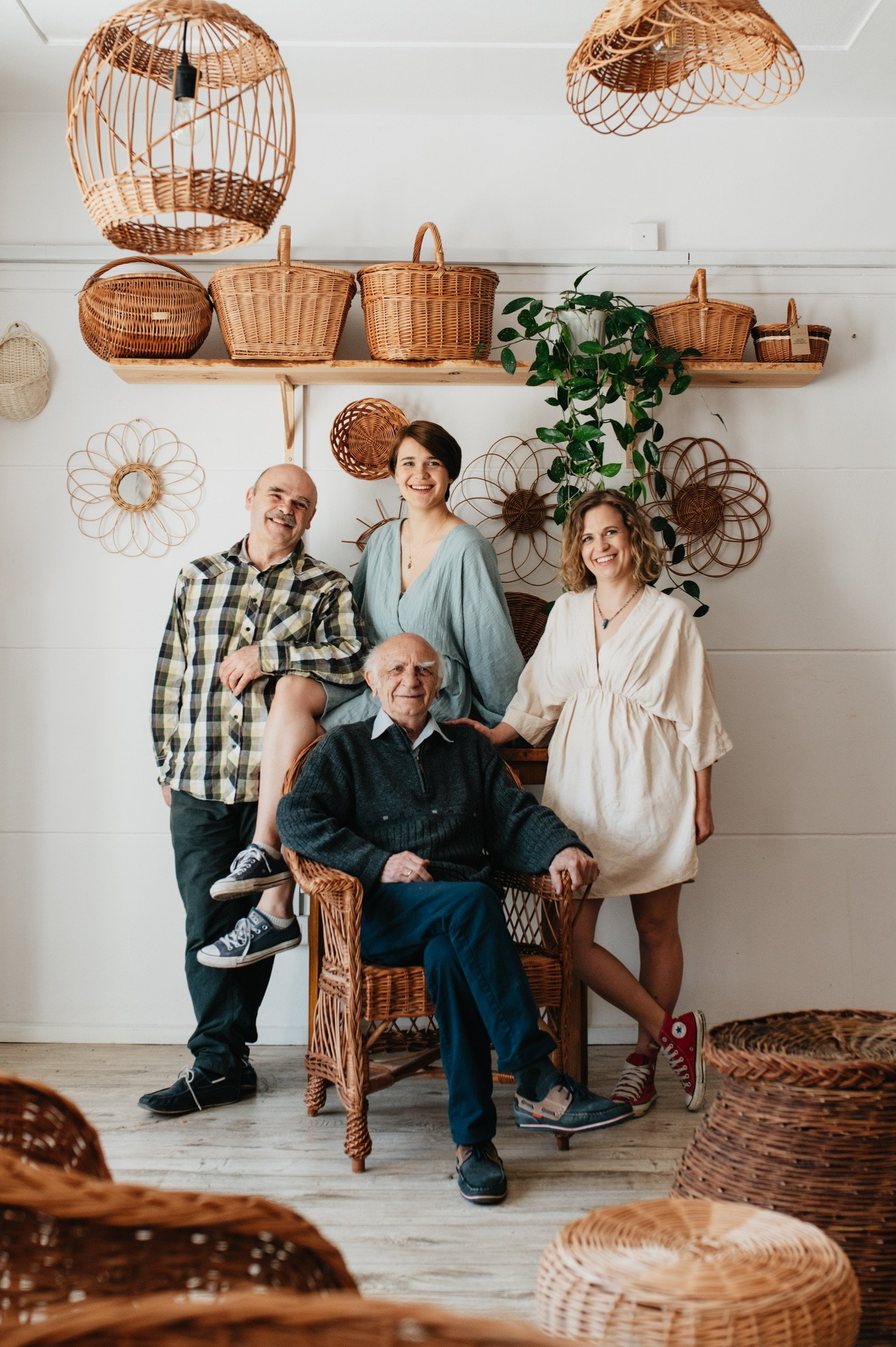
phot. Maja Hylewicz; promotional photo for the book "Wicker - beautiful things that you can weave yourself" by Znak Publishing House
In a world saturated with objects marketed as “handcrafted,” we increasingly find ourselves asking a simple question: Is it machine-made or truly made by hand? Basketry leaves no room for such doubt. It is one of humanity’s oldest cultural techniques shaped by patient hands, regional histories and a manual intelligence no machine has been able to imitate. It asks us to slow down, to notice how something both fine and functional can emerge from nothing more than material, touch and rhythm.
Poland has a long history of this craft. On the 10th of December this year, Polish Basketry Traditions will be inscribed on UNESCO’s Representative List of the Intangible Cultural Heritage of Humanity - a recognition that brings not only honour, but also the promise of safeguarding, visibility and renewed interest through education and boost for cultural tourism.
While the tradition stretches back generations, its heartbeat today can be found in new hands across the country. In Warsaw, one such place is unmissable: Siostry Plotą, a creative studio where a family story, nearly on the brink of disappearing, has literally been woven back to life by two sisters, Katarzyna Nejman and Anna Borecka.
Paradoxically, their story begins with an ending: the day their grandfather decided to close his wicker shop. For thirty years, Sylwester Nejman had sold baskets, furniture, and woven decorations from a modest storefront in Praga-Północ. “During the pandemic, only a few people came by,” Katarzyna recalls. “He wanted to close it, so I helped him organise a clearance sale.” What happened next surprised everyone. In just three days, more than three hundred people arrived, eager to claim the remaining pieces.
As the walls were stripped bare and the ceiling, once heavy with baskets, became empty, the sisters spoke with visitors who shared memories of wicker in their homes, stories of objects once made to last. For years, their grandfather had mentioned that more and more of his friends were giving up weaving, quietly fading away and taking with them patterns and techniques no one else knew. Watching the shop empty out felt like watching the broader reality of Polish basketry unfold in miniature - a once-vibrant craft slipping into oblivion.
This overwhelming response from strangers unexpectedly planted a seed of hope in Katarzyna and Anna’s minds. Perhaps this place and this craft still had relevance in the modern world? Perhaps the family tradition wasn’t meant to end here? The sisters took it as a sign and call to action. And today, with unmistakable pride, their grandfather Sylwester gets to watch the path he began continue forward.
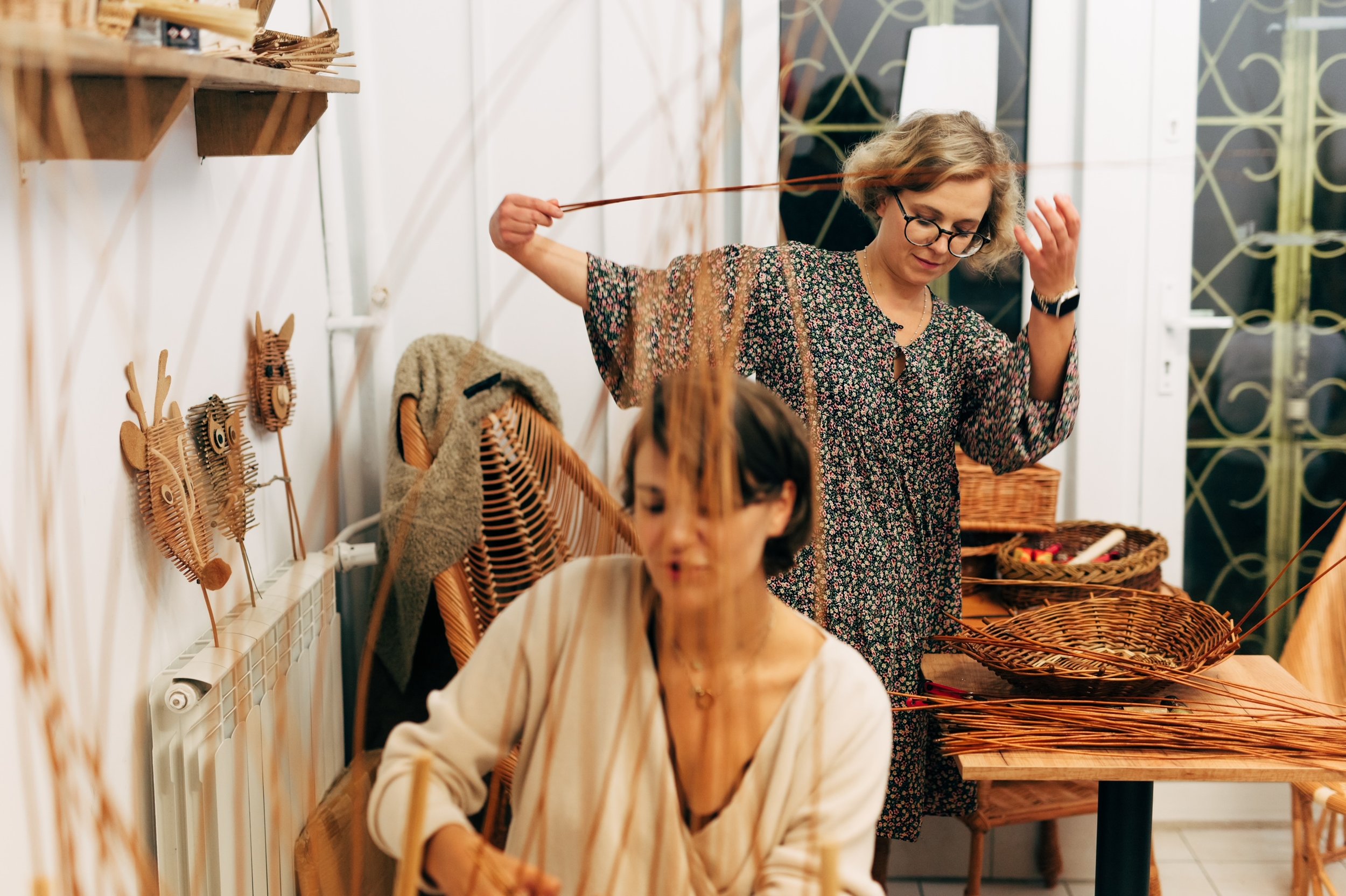
phot. Maja Hylewicz
It wasn’t nostalgia that pushed the sisters on. Taking over the family business in the midst of the pandemic was a brave and rather clear-eyed undertaking, and Katarzyna and Anna approached it with full seriousness - mindful that their grandfather had set the bar high for them.
Neither had planned to follow Sylwester’s path before. Kasia graduated from acting school, Anna worked as a graphic designer and art therapist. Yet their childhood had always been filled with wicker. “We grew up surrounded by it,” Kasia recalls with a smile. “We had so much of it at home. I even had a little wicker stroller that my mother used to push me around in.” What once seemed like unrelated backgrounds proved to be ideal foundations. Anna’s graphic design training helps her translate even the wildest ideas into clear, workable designs. Katarzyna with an acting background is a natural storyteller, with open and bright energy that gives the studio its unique pulse. “When I talk to clients,” she laughs, “we always say Sylwek switches on. People can feel grandfather’s energy, his joy and passion.”
Sylwester himself lived many lives before wicker. He studied at the Military University of Technology, served as a paratrooper and later worked as a sports judge. Basketry came later, introduced by a friend. In the early 1990s, when the Polish market was opening to the imported, mass produced goods from abroad, he wanted to create something rooted, local and meaningful. Something that supported people who worked with their hands. This ethos seems like one many people today can align with: a renewed appreciation for the handmade, a counterforce to mass production.
He wasn’t a craftsperson who sat for hours weaving. His passion lay in understanding the material and the people who mastered it, and in sensing the dynamic meeting point between the two. He knew precisely what wicker could and could not do, and for everything in between, he experimented. Part craftsman, part storyteller, part impresario of the everyday.
He built relationships with artisans across Poland, before “network” was a word. Together with his son (the sisters’ father) would drive from village to village, searching for the right maker for each object. “They gathered this whole spectrum of knowledge and contacts,” the sisters say. “That’s how it all really began.” When one weaver specialises only in suitcases, another only in lamps, another in impossibly specific basket shapes found nowhere else.. That's when it gets complicated. Sylwester would successfully bridge the most elaborate need with right skill.
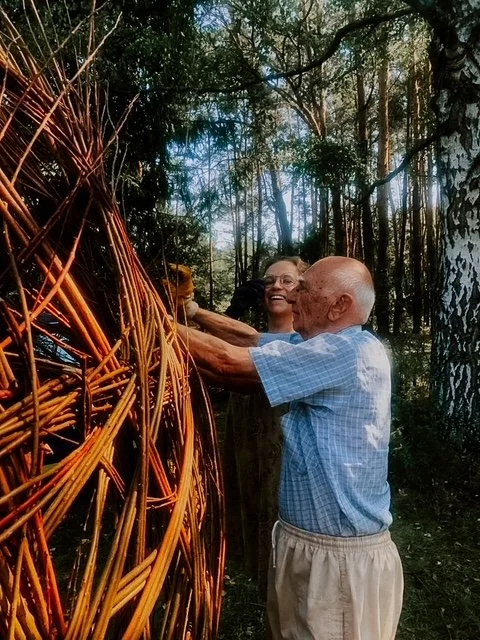
image courtesy of Siostry Plotą
His commissions were as varied as they were imaginative: props for theatre productions, oversized woven spheres for vaulted ceilings, lampshades for a Greek restaurant. Small baskets from Sylwester found their way into the Warsaw’s Blikle patisserie, the WARS dining cars of Polish trains and even Andrzej Wajda’s iconic Pan Tadeusz.
According to Katarzyna and Anna, “It can’t be done” was never part of their grandfather’s vocabulary. What the sisters inherited from Sylwester was not so much technique alone, as this open-minded approach, a firm belief that objects carry boundless potential within.. “Many craftsmen, when faced with an unusual project, tend to say, ‘No, that technique doesn’t allow it,’” Anna explains. “Our grandfather would never say that. He would always ask: What else can we try? How can we do it differently? What’s possible with what we have?”
Today, his granddaughters continue exactly that, with a contemporary sensibility and a deep respect for the past. “We are both trained basketmakers,” they underline. “It was really important to us to understand this craft properly, we want to do it at the highest level, always learning, always improving our skills.” Both completed vocational training in a school in Łowicz. Their father, already active in the business of their grandfather, was convinced to complete the program with them, and just like before with his dad Sylwester, he often supports them in their projects. “He is the meticulous one, calculating the exact angle of a lamp shade, creating custom forms, counting the number of rods required for each design.” Katarzyna jokes laughing that he is the one who ensures every product has a proper technical sheet.
But when it comes to conceptualising new ideas, he looks to his daughters. “If I tell him about a bag I dreamt of, some crazy, conceptual vision…” Katarzyna laughs, “he’ll say. Just make a prototype and I’ll figure it out technically. He can craft it perfectly, but he won’t invent it.” Anna, meanwhile, translates vision into clarity. She sketches, designs, and gives shape to concepts in a way that makes them comprehensible to everyone else. “Without each other, it would be difficult,” Kasia reflects. “I’m good with conceptualising vision, Anna gives it form, and our dad turns it into reality.” The two laugh that to complete the dream team, all they’re missing is a third sister, preferably one specialising in business management.
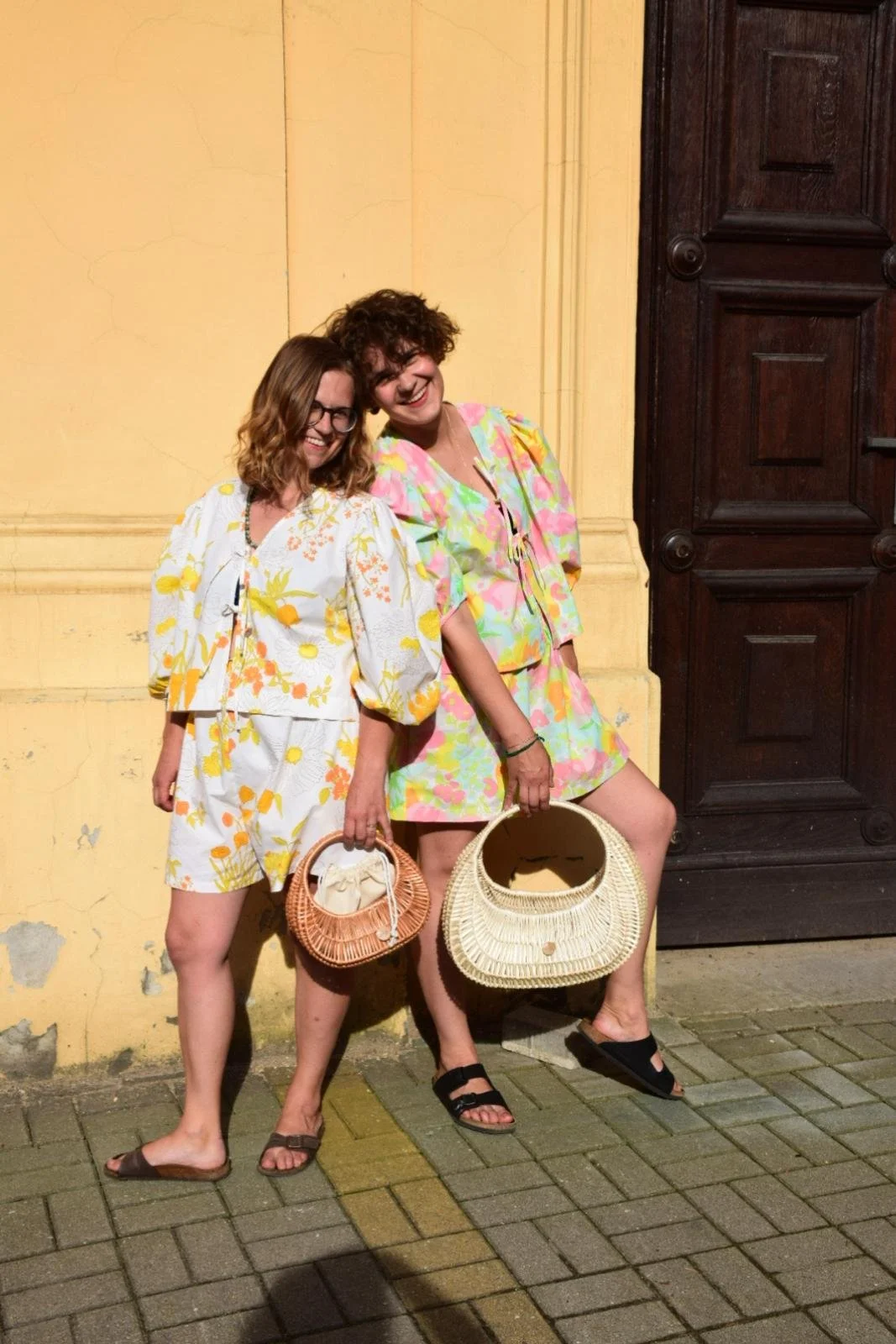
Katarzyna Nejman and Anna Borecka; courtesy of Siostry Plotą
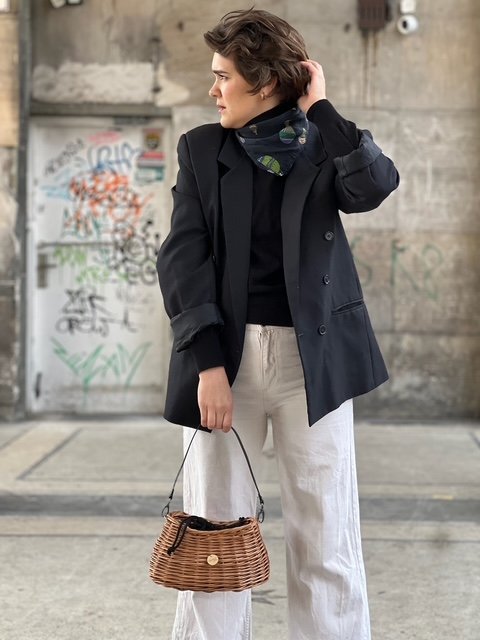
“Magnolia” bag; image courtesy of Siostry Plotą
The sisters spent their first year working in their grandfather’s tiny shop before moving just a short walk away to a larger space in Praga, staying faithful to the neighbourhood that shaped their family story. Today, their studio feels less like a store and more like an ideas laboratory, a place where tradition and experimentation sit comfortably side by side.
Anyone who believes wicker isn’t “for them” should step inside: the sheer variety of forms, functions, aesthetics and textures on display is greatly inspiring. Shelves hold traditional pieces by Polish artisans alongside contemporary designs by Katarzyna and Anna, sculptural forms, playful experiments and one-off artistic objects.
Despite having run their studio for a fairly short time, the sisters already have an impressive portfolio of realised projects: made-to-order objects for private clients, interior commissions, custom lamps and furniture, a refined collection of wicker bags, and collaborations with artists and designers. Their aim was never simply to recreate their grandfather’s world or to focus solely on profit and successful e-commerce. In the truest continuation of his ethos, they think forward imagining what this craft needs today, and how it can be expanded, shared and kept alive.
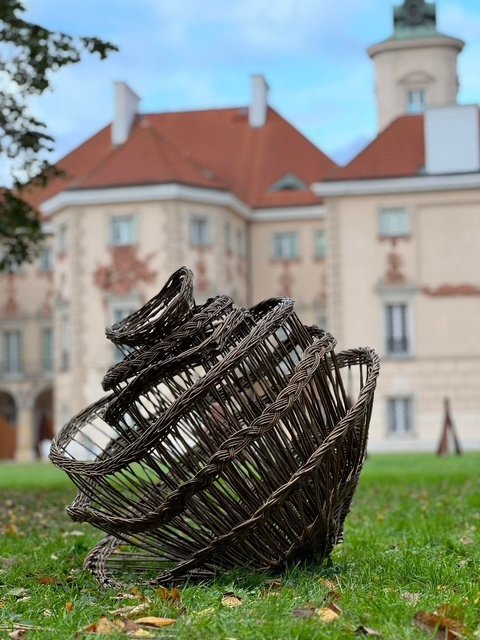
courtesy of Siostry Plotą
Even their name, Siostry Plotą, carries this spirit. In Polish it means both ‘to weave’ and ‘to chat’ which captures the constant buzz of conversation present in their studio and the flow of handwork. Siostry - the sisters - nods to the two of them, but also to the wider idea of sisterhood as kindness, solidarity, and community. “We love running workshops and exchanging knowledge. It is a cherished, essential part of our practice.” they share. For Anna, this thread began long before wicker entered her daily life: she spent years leading workshops for children and parents while working in a foundation, later studying art therapy. “We just have this flow when it comes to workshops,” she says, describing the intuitive choreography that unfolds once people gather together.
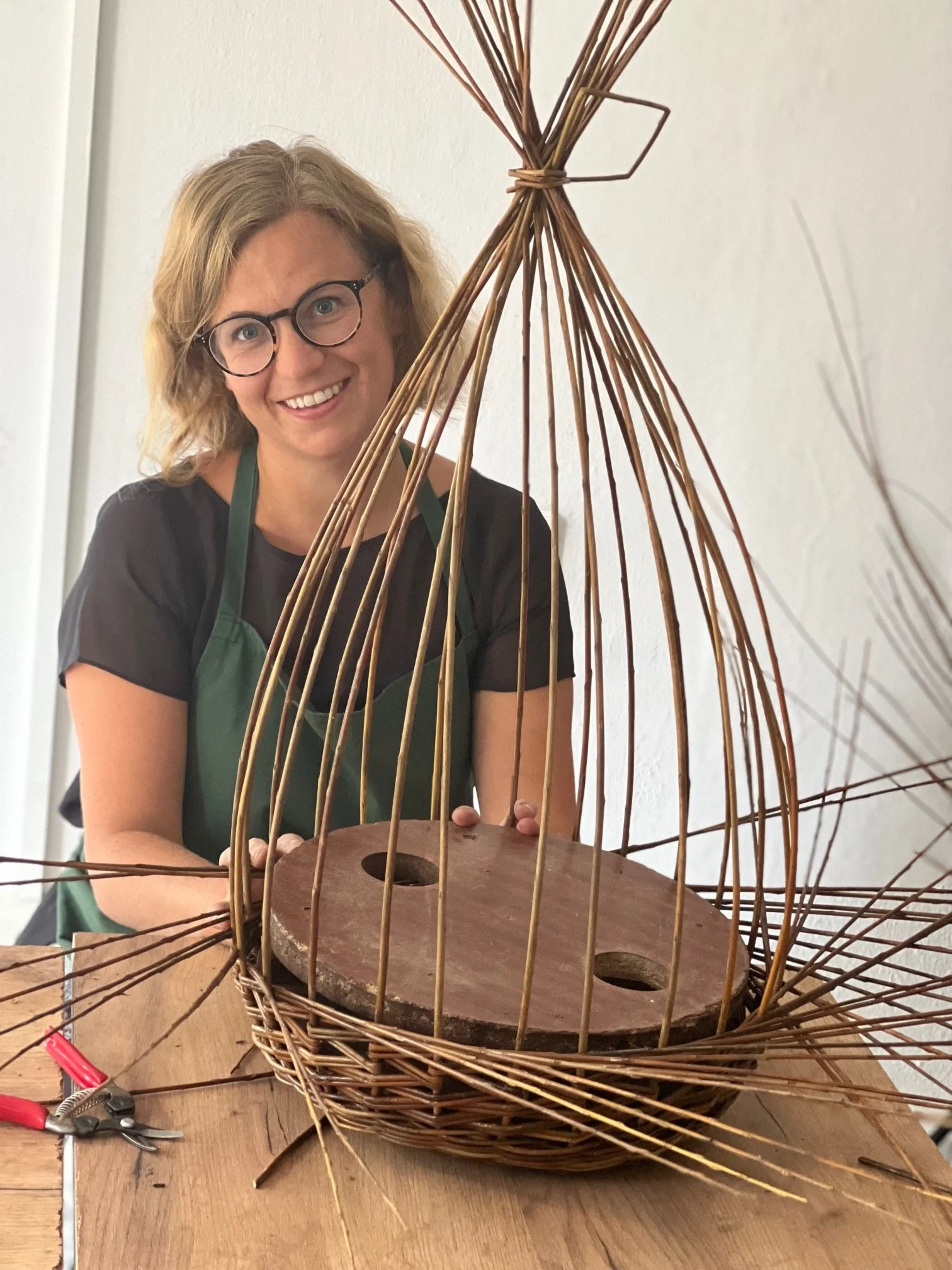
People often arrive out of curiosity and leave with something deeper. “Some tell us afterwards: I’m not sure I even like wicker… but I keep coming back because this feels like therapy,” Katarzyna laughs. In a city shaped by deadlines and fast pace, weaving becomes a kind of quiet act of rebellion.. “In our urban lives we rarely get the chance to listen to our soul,” she reflects. “But all creative forms - be it singing, dancing, painting or weaving are ways the soul speaks. And we’re all hungry for finding that outlet.”
The act of weaving itself offers a rare pause. “You sit for two, three, sometimes five hours, and you’re fully present,” Katarzyna says. “It resets the mind. It’s meditative, but also creative. (...) We never say: don’t do it that way, that’s wrong,” Anna adds. “More often it’s: I haven’t seen it done like that -try it, maybe you’ll discover something new.”
If you’re craving a similar experience, pop by their enchanting studio on your next trip to Warsaw.
For those admiring from afar, do follow their projects on Instagram and explore their beautifully crafted pieces online.
Got a dream, extraordinary project in mind? True to their grandfather Sylwester’s spirit, nothing is impossible with wicker. Katarzyna and Anna will surely take on the challenge!
All images courtesy of Siostry Plotą
WORDS BY PAULINA CZAJOR
____________________________________
Are you into crafts? Here’s more to read…
-Bobbin Lace From Poland
-Koniaków Lace
- Double Warp Weaving
____________________________________