Material Curiosity: Inside Kuba Święcicki’s Textile Practice
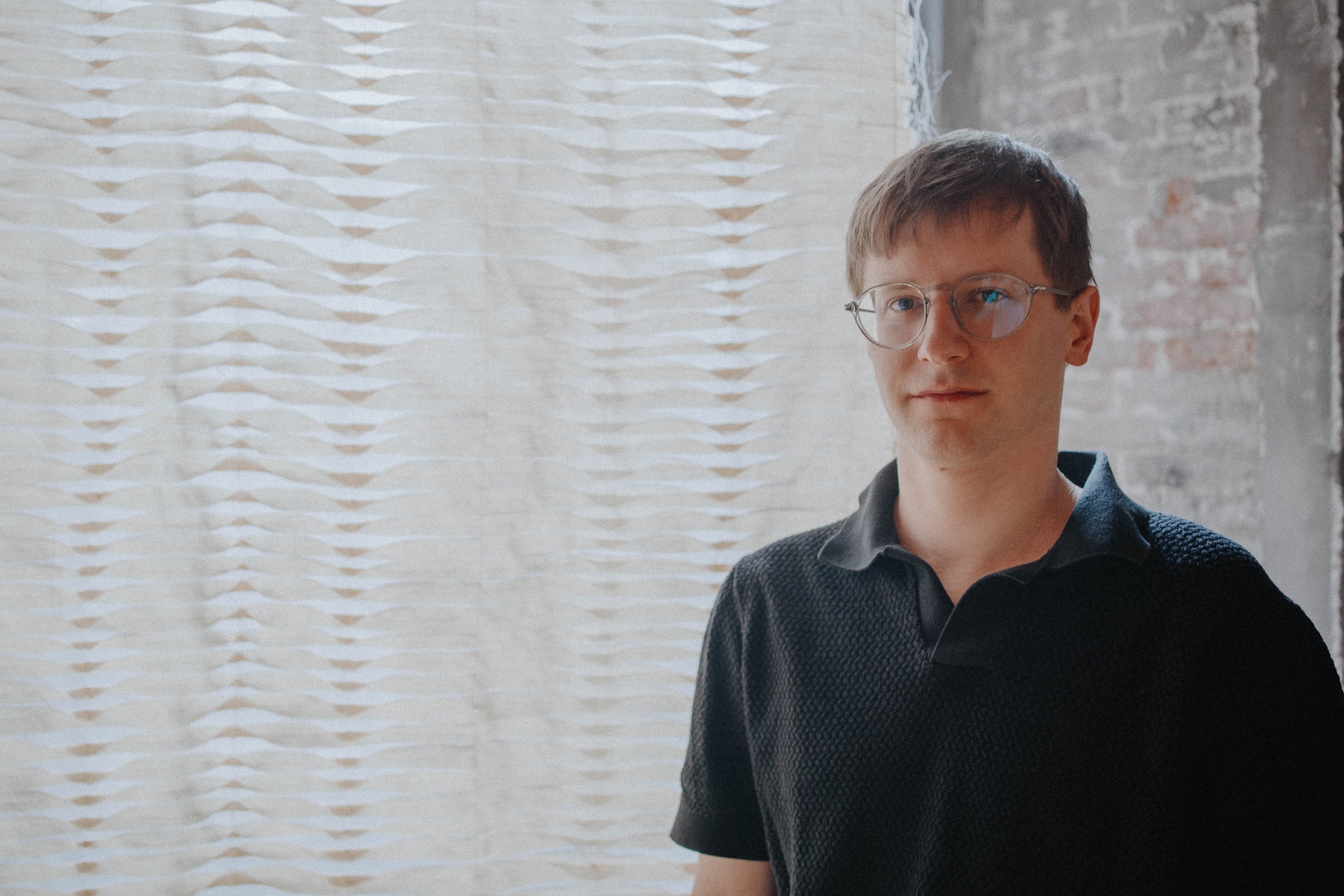
phot. Jeppe Lange
Kuba Święcicki rarely takes a material at face value. What others might discard, he sees as an opportunity to experiment; what might begin as a textile technique can become a question about sound, touch or how we experience the world around us. A pile of cassette tapes can form a woven curtain, construction-site can unearth a fantastic textile dye, and embroidery can offer a tactile way of experiencing the city. His work is driven by a persistent curiosity about what materials can do beyond their intended purpose and an ambition to put that potential to the test. He moves between machine embroidery, weaving, quilting and natural dyeing, with the aim, in his words, of “emphasizing textiles as active, experiential objects rather than passive surfaces”.
Święcicki balances his own practice with academic work. Born and raised in Kielce, he is now the artistic director of the Institute of Design, where he leads the Textile Studio, and an assistant lecturer at the Faculty of Art at his alma mater, Jan Kochanowski University. While his academic work keeps him rooted in Kielce, his artistic practice has taken him far afield, with projects and residencies in France, Norway, Hungary and China. His work has been shown internationally from Lima, through Bergen to Shanghai. Here, he talks about the materials, methods, creative journey and dreams ahead.
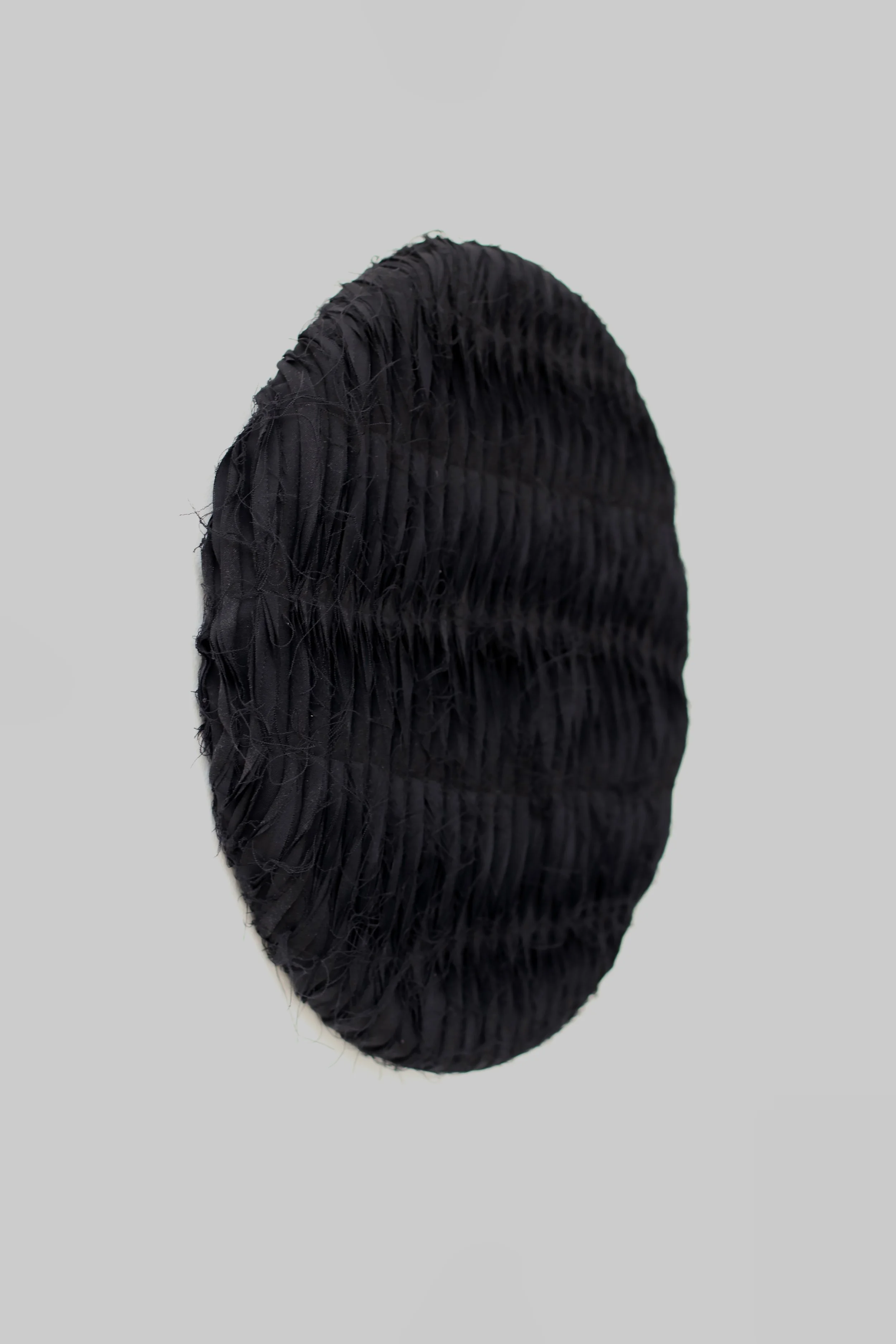
Black from the Monostriped Landscape series, 2025

Butter Yellow detail from the Monostriped Landscape series, faux-chenille quilt, 2026
Acoustics
In Święcicki’s hands, textiles become tools for problem-solving. Asked what he is currently working towards, he shares: “Creatively what I’m setting my sights on is exploring the acoustic properties of materials, it’s something I want to develop further. (…) I’m gearing up for a major research project where I want to create interior objects designed to improve acoustics and combat noise.”
Acoustics is a subject widely explored by textile artists, although the term “acoustic textiles” is sometimes used loosely. Święcicki, however, is not interested in speculation. Going head he wants to develop solutions that can be tested and proved to have a measurable impact. “I want to test it in a laboratory setting, to verify the actual parameters and determine whether the final product is viable and how it can be further developed.”
His starting point is a technique he frequently employs called faux-chenille quilting, in which several layers of fabric are stitched together in a regular pattern, with the top layers then sliced through to create a relief-like surface. “When I place these objects in my room or office, I know they improve the acoustics in some way,” he says, “but I’m curious about the extent of that, the specific parameters involved.”
This urge to look beyond the obvious runs through Święcicki’s practice. He often starts with a familiar material, or technique, and asks - what else it might do? Similar, curious spirit informs his approach to materials, particularly his interest in finding new uses for things that would otherwise go to waste. “I really don’t want to manufacture new things,” he explains. “The idea of a ‘second life’ for materials has always been important to me. I simply use items that are no longer needed; I work within the realm of upcycling, essentially. I often create these artworks out of what is essentially trash.”
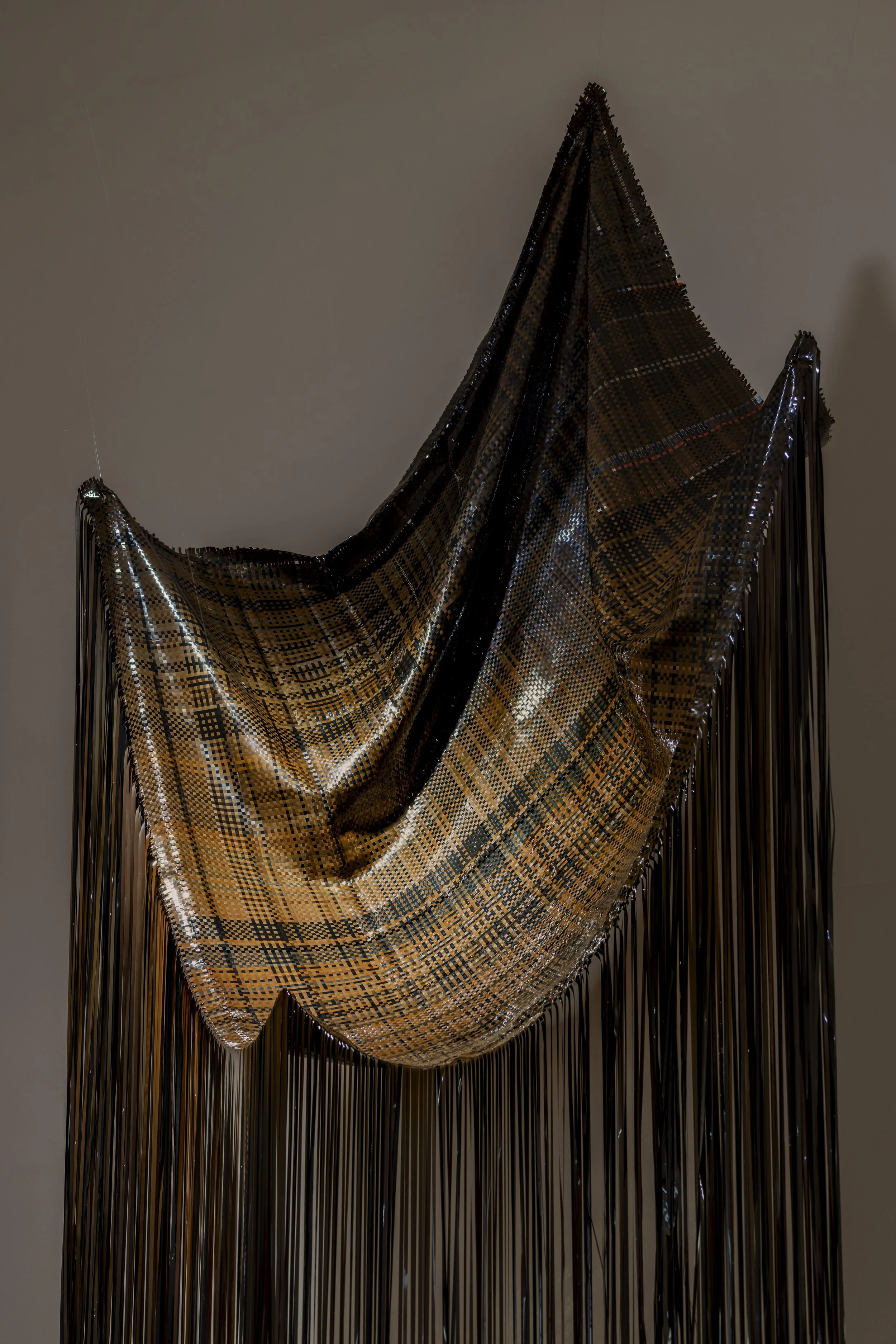
Heard Stories, phot. Alicja Kielan
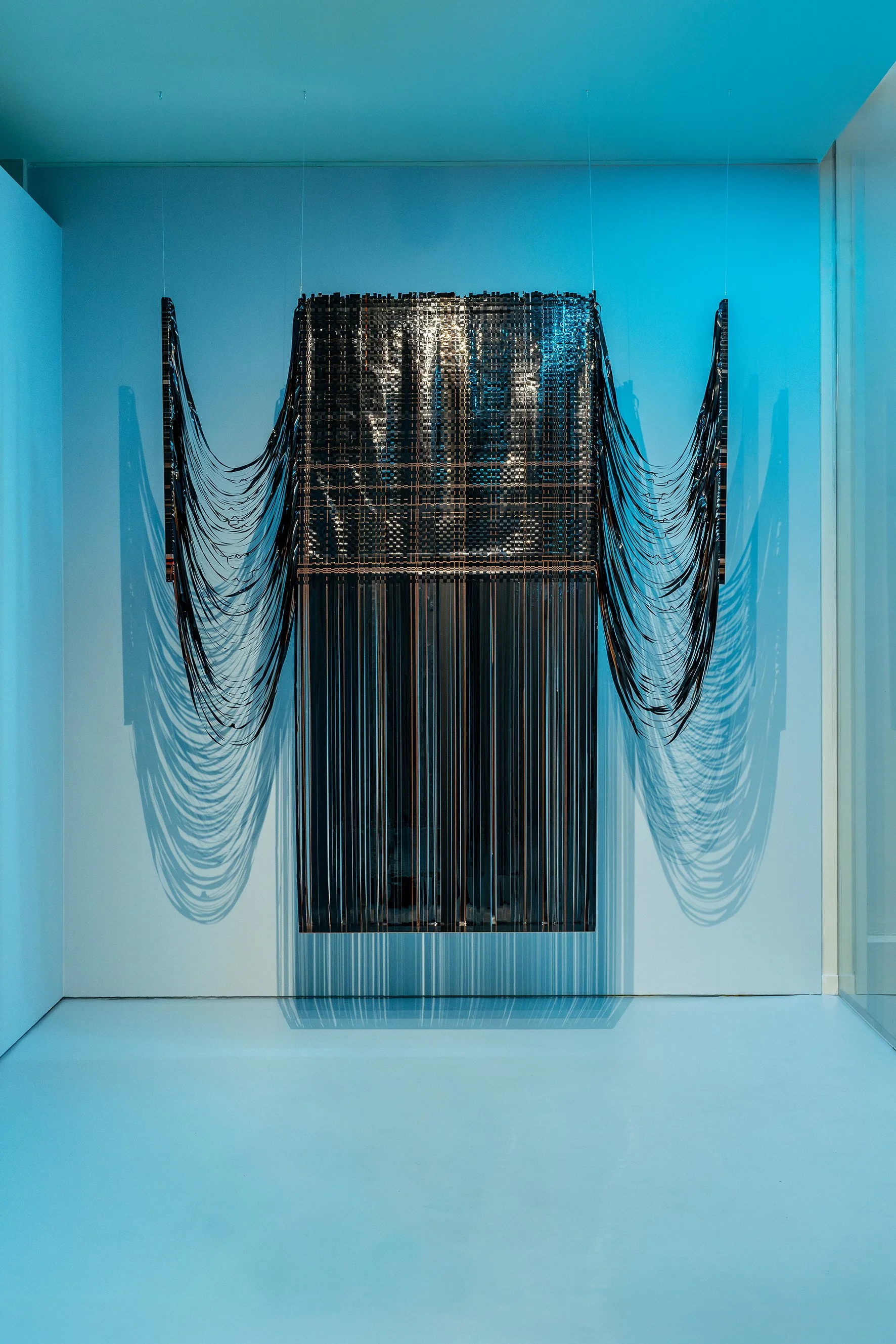
Stories Seen and Heard, phot. Alicja Kielan
Weaving with tapes
One example of this approach is a series of works made from magnetic tape. In ‘Woven Stories’, 'Stories Seen and Heard’ and ‘Heard Stories’, Święcicki transforms cassette tapes into lustrous, cascading pieces.
The tapes belonged to Święcicki, his friends and family. They contained music recorded from radio broadcasts, favourite TV series and cartoons from childhood, music compilations. By weaving the tapes together, he not only reveals their unexpected potential as a weaving material, but also brings together their embedded stories into one composition, nodding to the practices of borrowing, listening and collective viewing.
The work also shows how a personal archive of memories, with all its sentimental value, can resonate beyond the artist’s immediate circle when given a new visual presence. The tapes become something to look at and appreciate in their own right.“It was something completely useless to anyone else, at least at the time,” he says. “It was a readily available raw material, somewhat forgotten, and I wanted to elevate it to a higher status. To turn it into an object worthy of admiration, something where you can see it holds real value.”
Święcicki has an eye to see the potential in materials others might overlook. Yet, as he admits, finding them can be as time-consuming as the making itself, adding another layer to the process. It involves a lot of walking, searching and staying open to serendipity. “I’m often on the lookout for opportunities, like if I see a tree knocked down by a storm, say, and it has cones, I’ll gather them because they give me a beautiful color, you know? Or friends will save avocado pits for me when I need them, or I’ll go around to local greengrocers and collect produce that’s no longer fit for sale, simply because I know there’s great potential in it.”
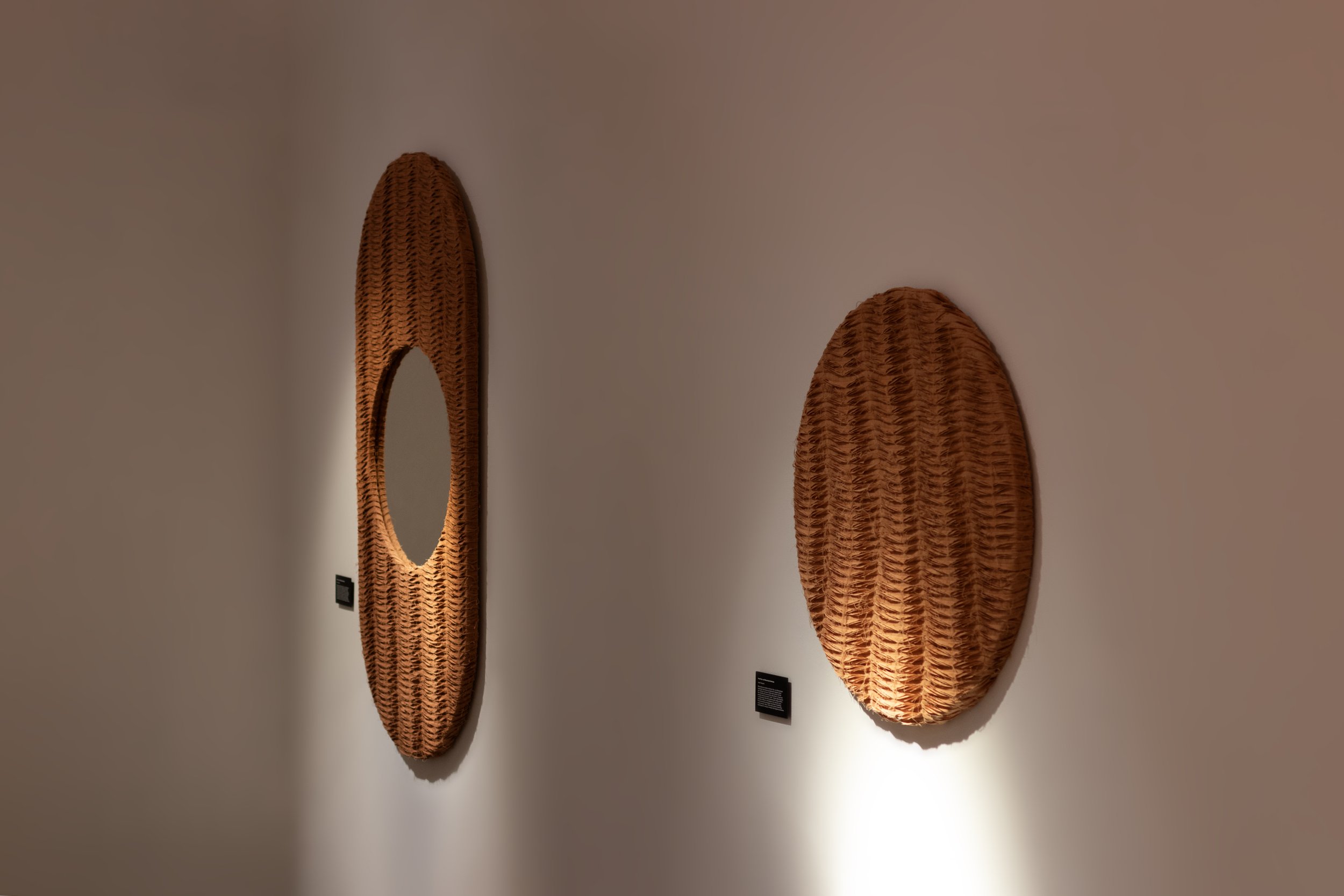
mirror and panel from Clay series
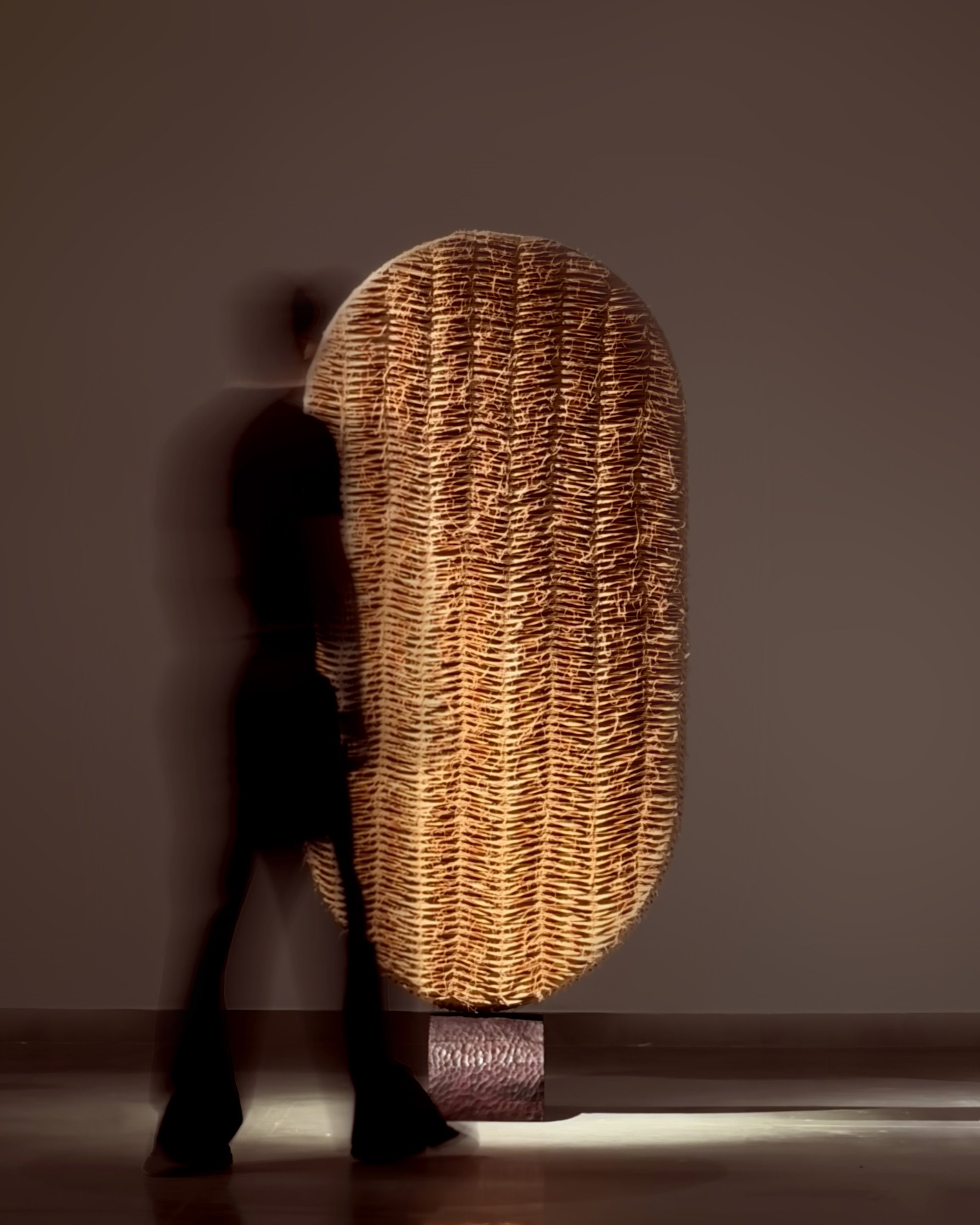
room divider from Clay series
Clay dyeing
Święcicki previously worked primarily with plant-based dyes, whose earthy tones shaped his colour palette, but more recently he has added a less obvious material to his practice: local clay. The discovery came almost by accident. While running a project with students at the Institute of Design in Kielce, he noticed that construction work in the neighbourhood was uncovering reddish clay. “In a way, the subject found me,” he recalls smiling. Clay is more broadly associated with ceramics, but through experimentation he found that it could also be used to dye fabric. It appealed to him both visually and in terms of his approach to materials: a locally available pigment with an organic, nuanced palette, whose shades shift with time and light. There is a practical environmental aspect that’s important too. “After the dyeing bath, you can simply pour the liquid out onto the grass, for instance, without causing any harm.”
These experiments led to ‘Clay’, a group of works within Święcicki’s ‘Monostriped Landscape’, a series of minimalist textile pieces combining form and function. The works include an acoustic panel and a mirror, as well as a room divider. Made using faux-chenille quilting and second-hand textiles dyed with clay, they draw on the agricultural landscape of the Świętokrzyskie region while making use of and celebrating one of its local raw materials. The divider is a collaboration with Adam Snochowski, who made its hand-sculpted mahogany wooden base. The piece was recently shown at ‘Craft Days ‘ at the Gawroński Willa in Warsaw.

Touching the City, Vienna Design Week 2024, phot. Emilia Milewska
Embroidery with impact
Embroidery, including machine embroidery, is one of Święcicki’s favourite techniques. He has collaborated with fashion designers, developing and producing embroidered elements for garments, but in fact, he is less interested in embroidery as decoration than in its tactile potential. “I believe embroidery holds far greater significance and potential than merely serving as clothing decoration. In fact, while working on my PhD over the course of four years, I used embroidery to organize inclusive exhibitions and create tactile graphics or typhlographics for the blind and visually impaired.”
During his doctoral research, he developed ‘Touching the City’, a series of exhibitions exploring the metalwork embedded in urban environments through tactile textile representations. The project began in Kielce before travelling to Kraków and Gdynia. Each edition was site-specific. In Kraków, for example, the exhibition focused on the metalwork of Nowa Huta and was held at the Norwid Cultural Centre, whose own windows feature metal grilles. Visitors could explore textile representations of these structures inside the gallery before going outside to touch the original metalwork themselves.
“I wanted to highlight a different, more socially engaged use for embroidery,” Święcicki explains. “Embroidery is wonderfully tactile. Its haptic quality allows for the creation of touch-based materials for those with vision loss, enabling them to actively engage with visual culture.” One visitor, who had lost their sight later in life, travelled from Katowice to Kraków to see the exhibition. It was the first exhibition they had visited in several decades. “That’s the best kind of feedback you could ask for,” Święcicki says.
The project reflects another meaningful principle guiding his work - design should begin with people rather than with purely aesthetics. “I almost never create mood boards,” he says. “I really value direct conversations with people; I like conducting in-depth interviews and getting to know the target audience.” For Touching the City, this meant visiting the Polish Association of the Blind, meeting people and connecting with their programme. Those encounters were essential to developing the project. “It really comes down to building a connection. That’s what I have to establish first before I can actually create something.”
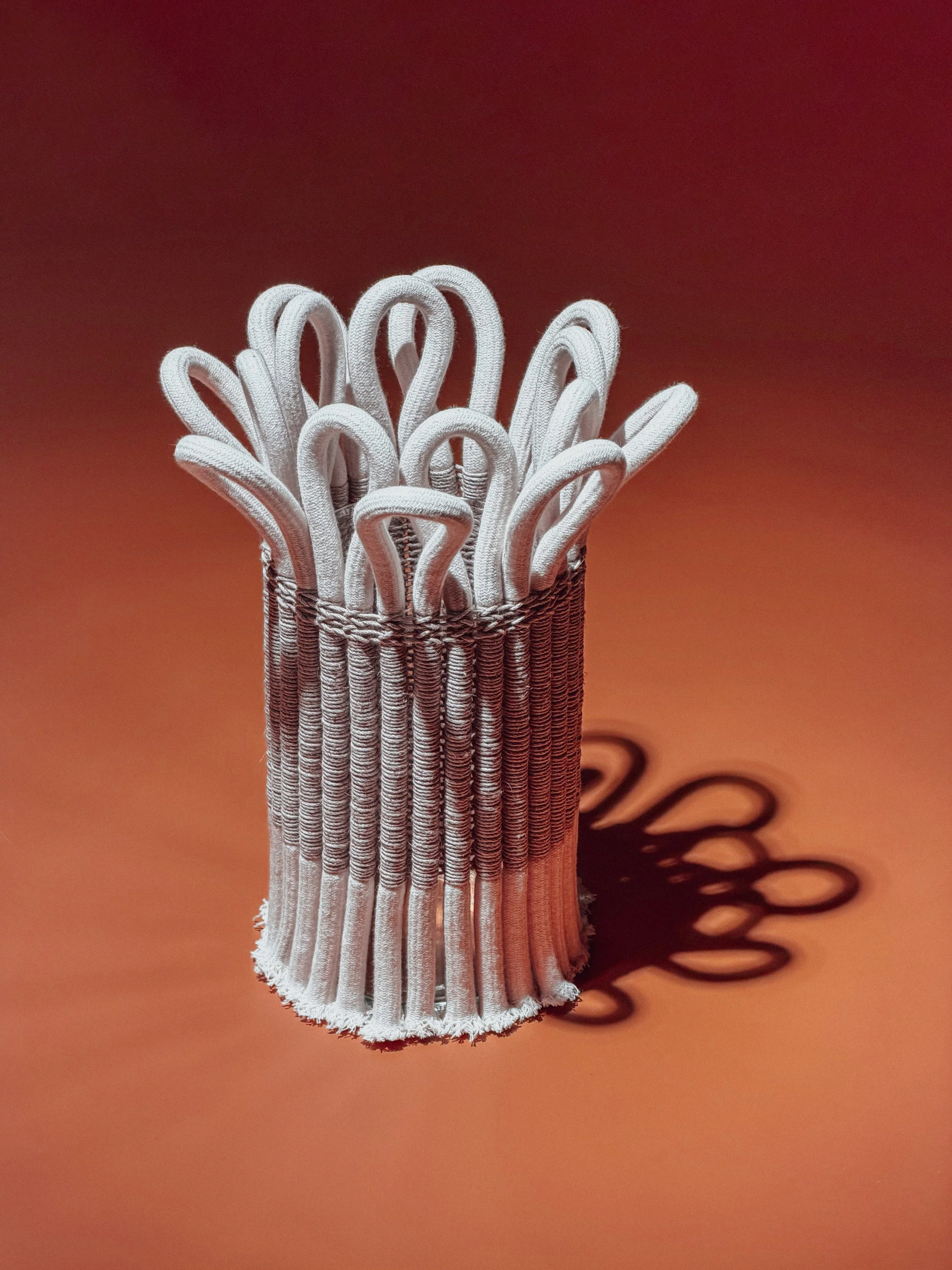
Vase from the Linen knots series, 2025
Chaos and Control
Asked about his methods, Święcicki describes them as “a mixture of chaos and control”. When working to a brief, he operates within a more rigid framework, but he also values the meditative side of making, both as an artist and a craftsman. “I also want to express my own aesthetic, but also simply meditate while creating the work,” he says. “The process itself is often very important to me, perhaps even more so than the final result.”
That mix of freedom and order seems to have roots in his childhood. At school, he imagined a career in a more analytical, maths-related field rather than art, but the hands-on side of making was already present at home. His father, as he recalls, was a “jack-of-all-trades” who taught him to make and repair things around the house. His sister attended a tailoring school, so there was a sewing machine at home, which Święcicki began using himself to make cushions and other domestic objects. “Looking back, I remember making some odd drawings early on, then a small weaving project in kindergarten, doing hands-on work with my dad, and later my sister having a sewing machine,” he says. “It ultimately led me to go to university thinking I’d be designing clothing and then focusing on textiles.”
He sees it as a series of circumstances that gradually connected, rather than a carefully mapped-out plan. “I think it’s less a matter of me choosing it and more a case of it choosing me,” he says. “I often believe there are no coincidences and that things eventually make sense.”
While art won over prior ambition in analytical subjects, the analytical side undoubtedly remained useful too. “That mathematical mindset really translates well to garment construction - working in 3D, having a sense of scale, being technically adept. Especially with the software involved - I often wanted to handle a lot of the graphic work myself, and that relies on a certain kind of logic.”
When reflecting on the people who have influenced him, Święcicki highlights cherished connections he has made along the way. “I really enjoy working with women, perhaps because I have four sisters and simply find it easier to get along with girls,” he says laughing. He learned macramé from Ewelina Kruszyńska, who “really showed me the ropes,” and counts carpet designer Joanna Rusin and Ola Bystry of Dzikie Barwy among those who immensely shaped his practice too. “Back when I was still a student, I really admired these people and their work. They were a huge source of inspiration and motivation for me.”

sh1, sh2, sh3 from the Monostriped Landscape series, phot. Jeppe Lange
Looking ahead
Of all the places Święcicki’s practice has taken him, China has left the strongest impression. During an undergraduate exchange, he visited Tianjin and Shanghai, where he was struck by the country’s technological development and by the ways traditional craft is reinterpreted through contemporary design. “There’s a movement there called Guochao, a sort of national trend that draws on tradition and folklore,” he says. “It’s not done in an obvious way, though; it’s more of a loose inspiration used to create contemporary designs. That’s really inspiring, and I think it could serve as a great example of how we might reinterpret Polish culture and traditions in a contemporary way.”
In 2024, he returned to Shanghai for a residency at the Swatch Art Peace Hotel. In keeping with his interest in working with locally available materials, he experimented with materials found around the city and in the hotel itself, including tea and coffee grounds, to create dyes. He then transformed the dyed silk through faux-chenille quilting. The resulting work is now part of the hotel’s collection.
He is already thinking about what he might explore on a future return to China. One ambition is to learn bamboo weaving. “I’ve already identified some places where they teach this kind of craft, like making baskets - but it’s not just about baskets; rather about the whole process, from harvesting the bamboo and processing it, all the way to creating a finished product. That’s definitely something I’d like to pursue.” he muses.
Other ambitions lie a bit further ahead. One is the Loewe Craft Prize: “I think that would be amazing. I don’t feel quite ready to apply yet - it’s something for the future.” Another, “perhaps a more practical one,” is to work with a gallery that could take some of the daily logistical burden off his shoulders. He names CoBrA GALLERY in Shanghai, which specialises in contemporary art and collectible design - “I’d love for them to represent me someday.”
Beyond textiles, there are other materials he wishes to explore, too. Glass is one, he mentions the glass artist Agnieszka Bar as someone he’d like to collaborate with. “So, Agnieszka - if you happen to read this and like the idea - consider this a wink!” he adds, laughing.
Ceramics and metal are also on his mind. “I also have an idea - which, of course, I haven’t managed to bring to life yet - about how to combine ceramics with textiles. I’ve also thought about learning to weld; in a way, metal appeals to me, too..” For a curious mind like Święcicki’s, the possibilities and ideas keep multiplying. “But one way or another, I always end up back with textiles,” he adds with a smile.
Visit Kuba Święcicki’s website and Instagram to see more of his work.
words by Paulina Czajor
More on textiles…
Soft Power - Aleksandra Gaca and her 3D textiles
“I see textiles progressing from a flat surface to a dimensional construction, from the wall to an independent object in space - and ultimately into a space itself”
Dzikie Barwy colour studio collaborating with nature
“Having artistic background, dyeing is creating for me. I am very interested in the aesthetic aspects of this phenomenon, much less chemical and physical. I want to bring you closer to the wealth that lies dormant in nature. Show that beauty surrounds us at every step.”
“Hours of working with variety of threads, textures, colour and patterns, passing through fingers kilometres of yarn results in something magic – a piece of fabric.”